
Someone asks “so who’s in your wedding party?” and suddenly you’re running through every close friend and sibling and college roommate, trying to figure out who makes the cut and what it means if they don’t. Before you’ve picked a date, you’re managing feelings.
It doesn’t have to start that way.
We’ve photographed weddings with parties of twelve, weddings where one person stood up beside the couple, and weddings with no formal party at all. The size of the party rarely reflects how meaningful the day felt.
None of what follows is a case against a big wedding party. It’s the set of things we’d want you to have thought about before you start making calls, because a lot of couples arrive at a number by addition rather than by choosing it.
Start with what you want, not who you owe
What do you want the ceremony to feel like? The morning of? Do you want a getting-ready room full of people and noise, or something quieter? Both are good days. They’re just different days.
A larger party means more hair and makeup appointments, more hotel rooms, more schedules to coordinate on a morning when coordinating schedules is the last thing you want to do. If that sounds manageable to you, it probably is. If the thought of it already feels heavy, pay attention to that.


The room you get ready in sets the tone
The getting-ready room is easy to treat as an afterthought. It’s the part of the day we’d most want you to think about.
We’ve seen all of them by now. Fifteen people in a big Airbnb with gifts and mimosas and somebody’s speaker going, and that is exactly the morning some couples want. We’ve also watched someone try to get their hair right while four people watch, and you can see what it’s costing them.
Neither one is a mistake. But the room decides a lot of it. A hotel room with one window is a different morning than a farmhouse with a porch.
Worth saying plainly: they don’t all have to be there. Somebody has small kids. Somebody’s driving in that morning. Somebody would genuinely rather show up at noon than at eight. Asking a person to stand beside you isn’t the same as asking them to spend six hours in a hotel room, and you’re allowed to want a smaller room than your party.
Think about it the way you thought about the venue. You picked a place that fits your guests and looks and feels the way you wanted it to. A getting-ready room does the same job for the first hours of the day, and those hours set the tone for everything after them.
What a bigger party costs on the day
Here’s the part couples don’t see coming. Wedding party photos take about the same time whether there are three of you or ten. Fifteen or twenty minutes, give or take.
What grows isn’t the photographing. It’s the finding. Getting ten people into one place at one time, drinks and phones set down, nobody in the bathroom, is the slow part, and it’s slow at every wedding. Our guide to how long each part of the day actually takes has the real numbers for the rest of it.
One related thing. If you’re not doing a first look, every group photo happens after the ceremony, which means your whole wedding party spends cocktail hour standing in a field with us instead of with your guests. With four people that’s nothing. With ten, a noticeable share of your party is missing from your own cocktail hour.
Think about the relationship now, not the history
The most common thing we see is a wedding party chosen on how long a friendship has lasted rather than its current shape. You’ve known someone fifteen years, but are you close now? Would standing beside you feel meaningful to them, or like an obligation?
Asking someone to be in your wedding party is asking a lot. Their time, their money, months of their emotional availability. A friend you love but aren’t currently close to might prefer to attend as a guest, celebrate fully, and skip a role they’re not sure how to fill.


There are other ways to honor people
Your wedding party isn’t the only way to make someone feel central to your day.
Some of the best moments we’ve photographed came from outside the formal party. A friend who officiated. A sibling whose toast stopped the room. A parent whose reading became the emotional center of the ceremony.
A few ways to give people real roles that fit who they are: ask a natural speaker to give a toast, even with no standing role in the ceremony. Asking someone to officiate is about as intimate a job as the day has, if you know them well enough to ask. Ask the cousin who’s a natural host to greet guests as they arrive, or the friend who cooks to help run the rehearsal dinner.
A role that fits someone is usually worth more to them than a dress they didn’t choose.
An assistant and a stage manager
We used to put “day-of point person” on that list of roles, and we want to be more careful about it, because we’ve also written that hiring someone to run your wedding day is the line item we’d defend hardest on a wedding budget.
Both things are true. They’re two different jobs.
A planner or coordinator is the stage manager. They run the timeline, handle the vendors, and solve a dozen things you never hear about. If you can have one, have one.
A friend is closer to an assistant, and the phone is the biggest part of that job. We’ve watched a lot of mornings where the bride spends most of hers texting. Where’s the florist, did the flowers make it to the church, is somebody picking up grandma. If you watched another bride’s morning go that way, you’d tell her that isn’t how to spend her wedding day. It’s harder to see when the phone is in your own hand.
So hand it to someone. They answer what they can and hold the rest until you’re ready for it. They tell the photographer which room you’re in. They go and find the coordinator when something needs finding. Small things, and together they move a whole category of low-grade decisions out of your head on a morning when your head is already full.
How much of this you need depends on the day. An intimate wedding with thirty people at a cabin has less to manage, and the question mostly shrinks. It also depends on whether you actually have that friend. The person for this is calm, early, and not the least bit offended at being handed a task. If nobody comes to mind, don’t force it on someone.
Who ends up in your photos
This is the one we notice most.
When we deliver a gallery, the people in it over and over aren’t the ones in matching dresses. They’re the ones who were near you. The friend who kept ending up at your elbow. The sister who never left. The person who made you laugh ninety seconds before the ceremony.
Someone can be in every posed group shot and barely appear anywhere else in the day. Someone with no formal role at all can turn up in a hundred frames because they never went far.
That isn’t an argument for a small party. It’s a reason not to think of your wedding party as the guest list for your photos. It was never doing that job.
Symmetry is overrated
You don’t need matching numbers. Three on one side and one on the other is fine. Your best friend standing with you regardless of gender is fine. As documentary wedding photographers, the handful of formal group portraits we take is a small part of our day, and an asymmetrical group has never once been a problem. Don’t build your wedding party around a photo you saw on Pinterest.
If a bigger party is right for you
If you want a larger party, have one. We mean that.
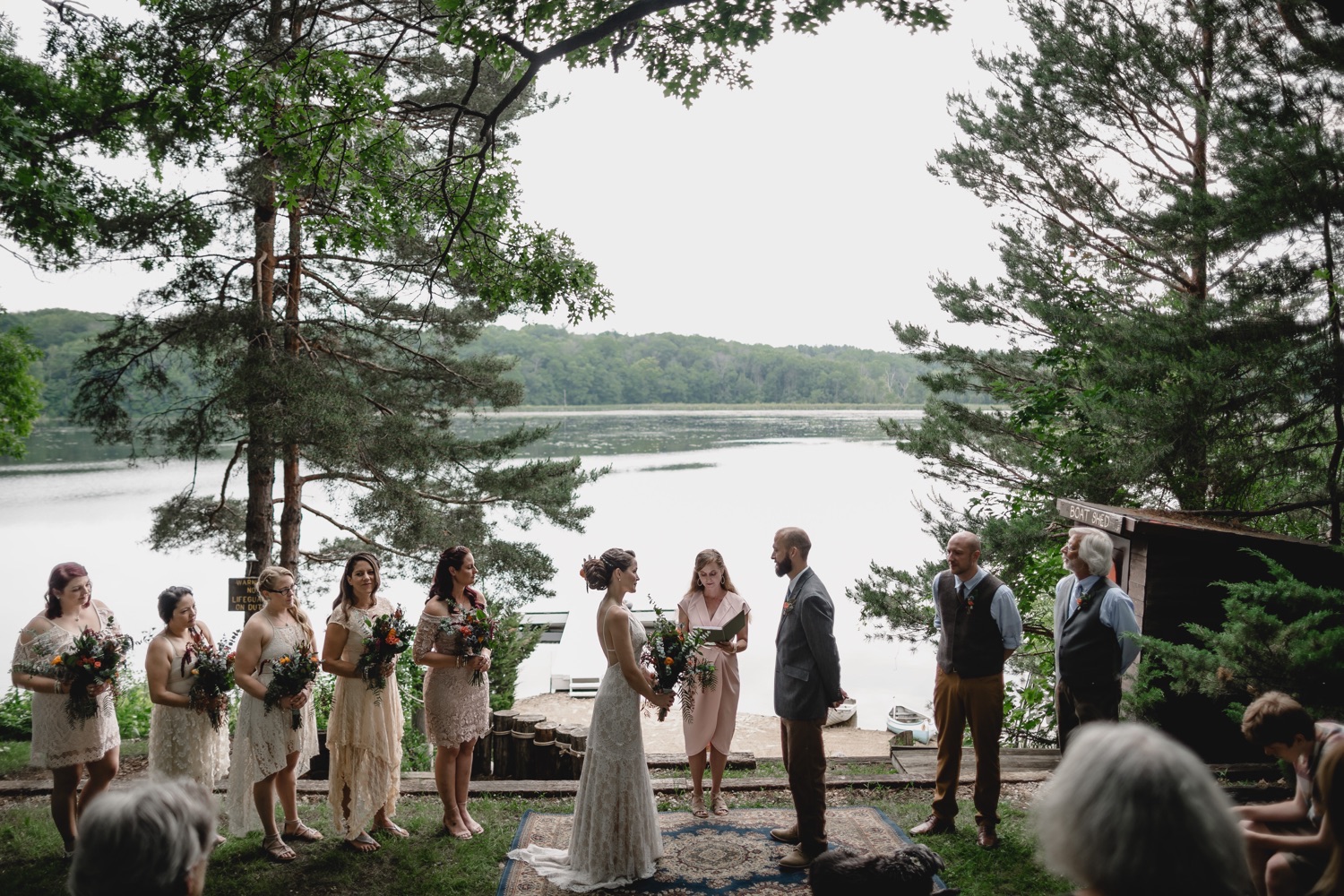
Some people are energized by a room full of their people, and their wedding should look like that. We’ve photographed mornings with twelve people getting ready together that were pure joy from eight a.m. on, and that day would have been quieter and smaller and worse with four. If your extended family is central to who you are, a full party makes sense. If you and your partner both have big groups of close friends you want standing with you, go for it.
The couples who seem happiest with a big party chose it on purpose. The couples who seem happiest with two chose that on purpose too.
The question worth asking
Who do you actually want beside you, and what do you want that to look like? Not who expects to be asked. Not who you’d feel guilty leaving out. Not who was in your party at their wedding.
Some couples land at eight and feel great about it. Some land at two. Some walk in together, alone, and let everyone else just be there. All of those are right.
If you’re early in planning and wondering what else is worth thinking through before the big decisions start stacking up, our Wisconsin wedding planning guide covers the rest of it in order.


